01North America
United States
- San FranciscoRoots
- Austin
A frontier AI operating system that
turns classical companies into AI-native ones.
We assemble your information into the core of the brain. We extract raw data from your CRMs and ERPs, clean and curate it, vectorize it and load it into the neurons. Silos that used to be separate become one source the brain can reason on.
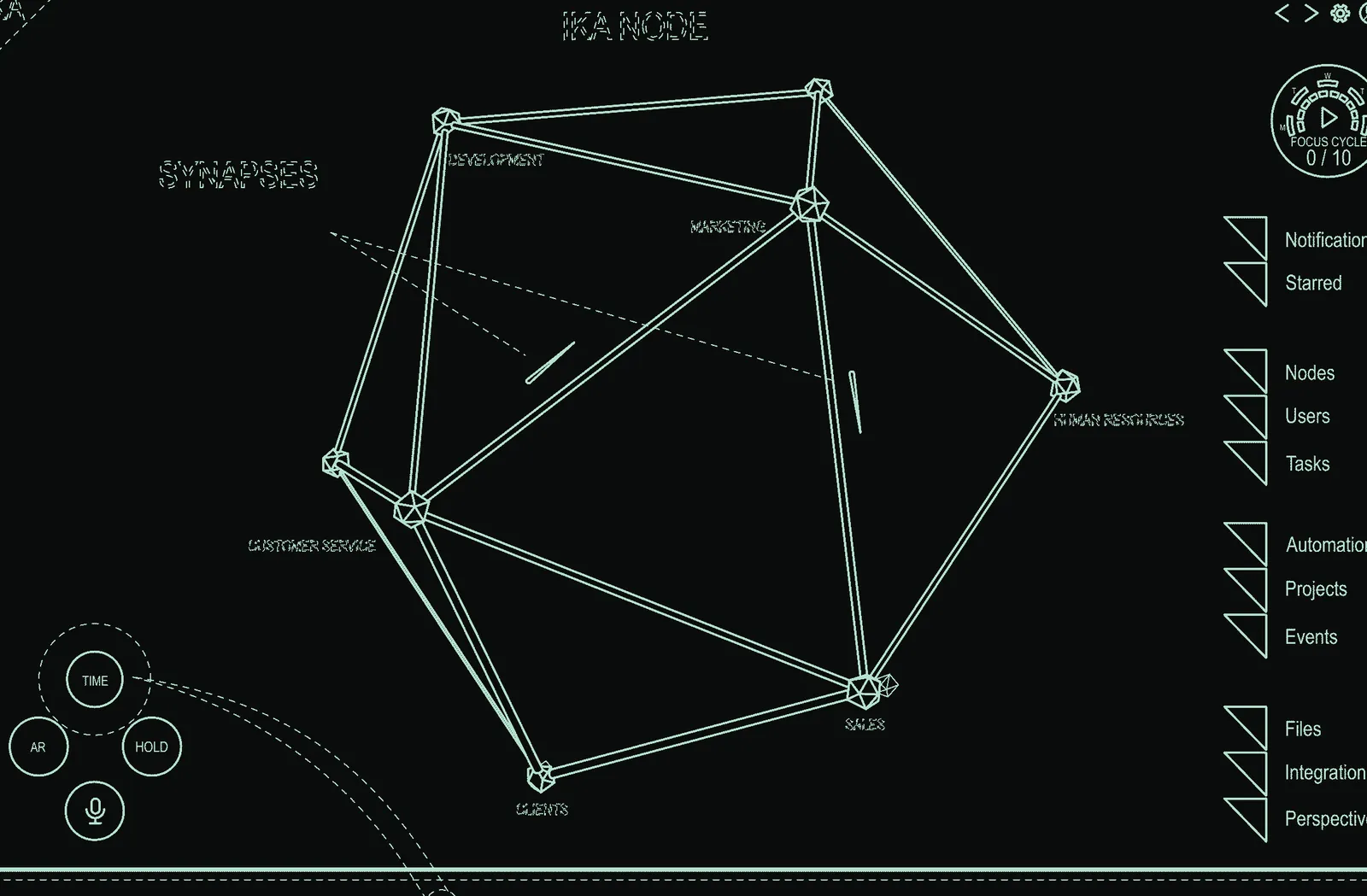
Process automation across the organization. Each neuron is a department with its people, tasks, projects, notes, events, artifacts and forms, shown as a timeline, calendar or list. It cuts the endless coordination and makes every step traceable.
Generative charts and data visualization across the whole company. Each neuron is a brand or business unit: open its KPIs, OKRs, analysis and reports, and ask it anything in plain language. Every metric you track sits in one view.
Foresight is a prediction layer over all of IKA. Charts extend into the future and tasks show how they will evolve. Once the data lake is assembled and the processes are automated, the brain learns from your global activity and tells you what is coming.
Clients and partners in Mexico, Guatemala, the United States and Central America, the markets we know best. In Europe we work from our home base in Amsterdam and are opening the German market.
Hover a region · 88 regions across three markets
Covered by international magazines and invited onto the largest tech stages in the region.













Industry leaders in Silicon Valley and Latin America have evaluated and endorsed IKA, among them design leads at Roblox and Amazon and the directors of logistics and consulting firms. The full letters open once you activate the demo with your email.
“A truly novel and groundbreaking AI Operating System… it sets a new standard with its unique immersive 3D interface, and its excellent autonomous agentic execution.”
“It genuinely feels like a tool pulled straight from the 2030's.”Read the letter
“IKA has revolutionised the way we manage our digital strategies. Productivity and efficiency have reached extraordinary levels — it has exceeded all our expectations.”Read the letter
“IKA has outstandingly transformed how we work — a significant rise in productivity. Its ability to adapt to our workflows is simply exceptional.”Read the letter
“Carlos Mats leads a talented team who understand sophisticated AI systems well enough to build something as unique as IKA. It will set a new standard for UX in the field.”Read the letter
“As founder of innovative companies such as Xchematic and IKA, he has shown exceptional leadership and a deep knowledge of Artificial Intelligence and Virtual Reality.”Read the letter
Three CTOs and a designer, each with about twenty years of experience. We bring Silicon Valley expertise and deep Latin American roots, so we know how the market moves and how people here work.

IKA stands for “Inteligencia Kinética” or “Kinetic Intelligence”. It is an Artificial General Intelligence Operating System (AGI-OS). Think of it as a second brain for your company, built as four shells around a core. The Data Lake connects silos that were never connected. Concierge automates processes and traces every step. Insight shows every metric. Foresight learns from all your global activity and predicts what will happen.
IKA combines the world's innovation capital and Latin America. We bring Silicon Valley expertise and deep roots in the region. AI is new ground almost everywhere. The field took off three years ago, and very few people have worked in it for five years, let alone ten.
We have. We saw this moment coming, and now we are building it. The four shells change how people work with information and how classical, pre-AI companies become AI-native.
That was the question that started the entire journey. And we started building the answer.
It resembled what ChatGPT turned out to be in 2023, three years early.
Already in operation, we launched in the Valley. The testimonials are in the Letters section.
Clients and partners in Mexico, Guatemala, the US, Honduras and Central America. In Europe, we are opening Germany from Amsterdam.
Four short essays by the IKA founders on AI as the base layer of every industry, and on the change already under way.
We get the same question in every first meeting: "But have you worked in our industry?" And we always answer the same way. When electricity arrived, nobody asked the electric company whether they had ever wired a shoe repair shop before. Nobody asks that about the web anymore either. Some technologies are the substrate every industry runs on.
AI is that kind of technology. It is industry agnostic, the same way electricity and the web are. A company without electricity or the web does not exist, and in a few years a company without AI will not exist either. This shift is moving faster than the internet did, and the internet remade the world in a decade.
We have spent nine years building for this moment and three years watching enterprises adopt AI in real time. We know who the early adopters are, what broke and what worked. We install intelligence into companies, whatever they make, from wine to logistics. Get on board.
Every generation is told its technology changes everything, so skepticism is fair. This time is different for one structural reason. Electricity did not improve itself, and neither did the web. AI does, and it already is: coding agents now write most of the code at the frontier labs. The tool is building the tool.
That is a recursive self-improvement loop, and we are in its first turn. Our intuitions about adoption timelines come from electrification, the web and smartphones. They are too slow now, because each generation of the technology speeds up the next.
Code runs the world, and now anyone can write instructions in plain language and have them executed. The more you can do, the more you achieve, and the faster you achieve, the further ahead you get. That compounding decides who leads. We rode the wave from analog to digital. This one is a tsunami, and we have watched it form for nine years.
We are already in AGI. We are at the threshold, early in a transition with blurry edges. Call what we have today a proto-AGI. Then run this test: ten years ago, if you had asked any of us whether a system with today's capabilities counted as AGI, we would have said yes without hesitation. The goalposts moved. The milestone stayed where it was.
We called it in 2023: this is the first step. What the field projected for 2060 is arriving thirty-five years early. There is road left, and the move from LLMs to world models is how we reach the full version. The phase change has begun. It leads to artificial superintelligence and, we hope, to answers about how the universe works.
We have held this view for years. We started IKA in 2017, and the first version, built in 2020, resembled what ChatGPT turned out to be in 2023. In 2026, more than halfway to 2030, the answer is coming into focus and it matches what we expected. We believe this is the most important human shift so far. We are glad to be alive for it, and we are building for it.
Physics had to invent a word for everything that came before quantum mechanics: it called it classical. Classical physics still works, but its assumptions stop holding once you look closer. Business is at the same boundary. On one side are classical companies: pre-AI, manual, siloed, often not fully digitalized. On the other are AI-native companies. The distance between them is the distance between classical intelligence and quantum intelligence.
IKA closes that distance. We assemble your data lake, automate your processes, connect the silos so the brain can reason across them, and put a layer of foresight over all of it. The result is a second brain for the company. Depending on your size, going from the caves to the space age takes three months to a year.
Across Latin America, many organizations never completed digitalization. That gap now works in their favor: they can leapfrog the digitalization age and land directly in the AI age. The companies that make that jump will operate under different physics from their classical peers.
 USPTO · Granted 2024 · Fig. 1
IKA's core method is a granted United States patent. It covers the immersive 3D fractal interface and the AI harness that let authorized users speak to, see and act on the entire operation. Inventors: Carlos Mats & Carlos Cerrato.
IKA runs on enterprise-grade infrastructure managed by our team, isolated per client, encrypted everywhere and audited end to end. Where it runs is your call: cloud, hybrid or fully inside your walls.
Enterprise-grade infrastructure managed entirely by IKA. Nothing to install or maintain, distributed with no single point of failure. The most common choice.
Sensitive data or sites with unstable connectivity run on your premises; the rest runs in the cloud. One system, two locations.
IKA installed entirely inside your own infrastructure, for organizations whose data cannot leave the building.
The platform configuration aligns with the international information security management standard, protecting every client's operational and financial data.
European and Latin American data protection principles applied to personal information: consent, minimization, limited retention and data-subject rights.
SOC 2 controls for operational security, availability and confidentiality, and PCI DSS compliance for any payment data flow.
AES-256 at rest with managed keys. TLS 1.2+ in transit for every connection. Customer-managed keys (CMK) available when full control is required.
Integrated authentication with your corporate identity. Role-based access control at the data lake zone, database, table and column level. Row-level security per client. Mandatory MFA for administrators.
Each client's data is tagged by tenant and logically isolated. Nobody sees another organization's information.
Private virtual network with private endpoints to storage and compute. Firewall with IP allow-lists. Administrative access only through VPN or bastion.
Dynamic masking of personal fields according to the viewer's role. Tokenization of identifiers used in joins across sources. Automatic classification of sensitive data.
Immutable record of every access, query and change, retained for twelve months. Centralized logs with automatic alerts on anomalous patterns such as exfiltration or off-hours access.
Thirty-day retention for operational data, longer for accounting data, adjustable per client. Point-in-time restore. Optional geographic replication.
Data sent to AI models for inference is neither stored nor used for training. PII is filtered before any context reaches a model, and every query to the assistant is logged.
Every dataset, source, schema, owner and field-by-field lineage is registered in the data catalog.
More than one hundred automatic tests run on every load. A failure blocks promotion to curated data.
Single, canonical definitions for every business term, published in the catalog so everyone measures the same thing.
A RACI matrix per dataset: owner, custodian and authorized users. Built in the first phase of every implementation.
Every IKA plan includes a yearly batch of tokens, the unit of work of an AI model. IKA routes each task to the right tier so light work never pays for heavy models. Move the sliders, drag the chart: this is the same visualizer we use in proposals.
Every one of these questions came up with a prospective client, and every other client asks the same. Here is how IKA answers them.
IKA is an operating system for companies, built for the age of artificial intelligence. Think of it as the Mac or Windows of a post-PC world: one system that runs your operations, your data and your decisions, and that you simply talk to.
IKA turns a classical company into an AI-native company. In ten years every company that is still classical will be gone, so this is the transformation we deliver.
You talk to it. Type or speak what you need, in plain words, even sloppy ones, and IKA does it or asks you a quick question back: "do you mean this or that?". There are no menus, drop-downs or clicks to memorize.
Every person gets a custom interface for their specific job. Someone whose only task is to upload invoices takes a picture with their phone and is done. A manager sees KPIs, OKRs and can ask anything. The system is simple because it is custom made for each role, not because it hides features.
Yes. IKA was designed for exactly that situation. Access is role-based: each person receives only the capability their job needs, nothing more. The person who approves purchases approves purchases. The person who uploads documents uploads documents. Nobody is handed more power than their role calls for.
Humans stay the decision makers. IKA prepares, suggests and executes the busywork, and asks for approval where the process requires it. In practice the technology makes the work more human: people stop compressing their thoughts into forms and simply say what they need.
It starts with a discovery phase. Together we map every process on two axes: how frequent it is and how critical it is. The frequent and critical ones are the goalposts with fixed dates. The frequent but low-priority ones are the quick wins, and we automate those first so the company feels the change in weeks.
A forward-deployed engineer from the IKA team, with full access to the platform, goes department by department to build that matrix with you. From there we set the timeline and start delivering.
A full transformation from classical to AI-native company takes less than six months. Companies with few existing systems move faster, often around four months, because there are two or three integrations to build instead of the twenty-five a large enterprise carries.
No. Keep whatever already works for your team. IKA connects to your existing systems and builds everything else around them: the operations, approvals, reporting and automations they do not cover. You stop paying for new modules and developers every time you need a change, and you avoid the forced upgrade cycle those platforms impose.
Monthly software subscriptions are being absorbed by AI platforms. You do not have to remove them on day one; IKA grows around them and replaces them at your pace.
Yes. Country-specific integrations such as tax authority invoicing are part of the implementation. They are small, well-defined jobs and IKA builds them custom for your country and your business instead of waiting for an international vendor to support them.
Yes. Permissions follow the hierarchy of the company and every process has defined steps, roles and approvals. If a purchase needs two signatures, IKA collects two signatures. If a role cannot see finance, it does not. Best practices are built into the processes themselves, so the system guides people who do not yet have the experience to know what not to do.
Your team logs into IKA with a username and password, from a computer or a phone, and has access to their work. Where IKA runs is your decision, and we build each client the setup their needs call for:
During discovery we look at your data, your regulations, your locations and your connectivity, and recommend the model that fits.
No. IKA handles whatever volume you throw at it, from one office to a network of sites. The one thing each location needs is connectivity; a satellite link is more than enough. Power and coverage issues at specific sites are surfaced during discovery and the setup is designed around them.
In what we save you: time, energy, money and resources. Dashboards are the visible part; the saving is in the processes behind them.
No. A phone with fingerprint or face unlock is all it takes. People sign in and approve anything with the biometrics they already use every day.
Define them inside IKA. A process is created by describing it in words: "create a process called quote approval, step one upload the purchase order, step two review by the finance assistant, step three approval by the finance manager, notify the general manager". IKA shows the flow, you adjust it in conversation, approve it, and every user is notified. That is faster than documenting processes on paper and then paying someone to implement them.
Trimming the organization and defining processes is valuable work. IKA is where that work lands, so the two can happen at the same time.
You are in it. this portal is a live demonstration: open the departments, see how an AI-native company operates. For your own company we run a private session with your leadership team so everyone sees what is possible before the discovery phase begins. The goal is always the same: save time, money and resources.
IKA runs on enterprise-grade infrastructure managed entirely by our team, aligned with ISO 27001, SOC 2, PCI DSS and GDPR / LGPD principles. Your data is isolated from every other client, encrypted at rest (AES-256) and in transit (TLS 1.2+), and reachable only through role-based access with mandatory multi-factor authentication for administrators.
Personal data is masked according to who is looking at it, every access and query is logged immutably for twelve months, and backups allow point-in-time restore. Every call to an AI model runs with Zero Data Retention: nothing you send is stored or used for training. The full list of controls is in the Security section.
Tokens are the unit of work of an AI model: every question, document, analysis or automation consumes some. IKA includes an annual pool of tokens and routes each task to the right tier: frontier models for deep reasoning and long context, mid-tier models for everyday analysis and multi-step work, and small models for classification, embeddings and high-volume tasks. Light tasks never pay the price of heavy models.
The pool is sized during discovery from the frequency and weight of your processes, and it is yours to distribute across the three tiers and across the year, with seasonal peaks. The Tokens section has the same interactive visualizer we use in proposals, so you can see how a plan behaves before signing.
Turnkey: We handle hosting, security, tokens, project management and the full ETL. From the caves to the space age in three months to a year.